Why We Steer Clear of "Special Needs"
October 21, 2024
Language holds immense power in shaping how we view and treat others. At KIT, as advocates for inclusive spaces for children with disabilities, we carefully select our words to promote respect and understanding. Disability is a multifaceted aspect of human experience, and there’s no single “correct” way to discuss it—especially for those with disabilities or their families. However, we prioritize language that is respectful, clear, and empowering, avoiding terms that may perpetuate stigma or ableism.
We use both identity-first language (e.g., “disabled child”) and person-first language (e.g., “child with a disability”) based on context. We also align with the #SayTheWord campaign, championed by disability rights advocate Lawrence Carter-Long, which encourages the use of “disability” rather than euphemisms. As Carter-Long noted in an NPR interview, avoiding “disability” can minimize its real impact: “To act like disability is just a ‘difference’ with no effect on someone’s life is a privileged perspective most disabled people don’t share.”
How Language Shapes Inclusion
Creating inclusive environments for children with disabilities involves addressing both physical barriers (like inaccessible spaces) and societal attitudes (like assumptions about their capabilities). The words we use play a critical role in either reinforcing or dismantling these barriers, influencing how inclusion is perceived and practiced.
While “special needs” is often used with good intentions by parents, educators, and caregivers, many in the disability community find it patronizing and stigmatizing. Studies suggest that “special needs” carries more negative connotations and causes confusion compared to the clear and direct term “disability.”
Why We Avoid “Special Needs”
We choose not to use “special needs” for three main reasons:
- It implies abnormality: Every child has needs—whether for communication, social skills, or emotional support. Labeling the needs of children with disabilities as “special” suggests they are outside the realm of typical human needs, which is misleading.
- It’s a euphemism: Terms like “special needs” often stem from discomfort with directly acknowledging disability. At KIT, we view disability as a natural part of human diversity that deserves clear, honest language.
- It lacks legal grounding: Unlike “disability,” “special needs” has no legal standing under laws like the Americans with Disabilities Act (ADA) or Section 504 of the Rehabilitation Act, which ensure access and inclusion for children with disabilities in childcare and youth programs.
Human Needs, Not Special Needs
All children require support to communicate, build relationships, and navigate challenges. These needs vary in degree but are fundamentally human, not “special.” A compelling video for World Down Syndrome Day humorously highlights that the needs of those with disabilities are not unique—they’re universal.
Euphemisms like “differently abled,” “challenged,” or “special needs” are often used to sidestep the word “disability.” However, at KIT, we see “disability” as a neutral, factual term—not something to avoid. As children with disabilities grow, they’re more likely to embrace “disabled” as part of their identity rather than “special needs.” We encourage children to speak confidently about their disabilities and advocate for their needs.
Ensuring the Right to Inclusion
The ADA and Section 504 guarantee children with disabilities equal access to childcare and recreational programs. When educating childcare professionals, we emphasize that these legal protections hinge on the term “disability.” Using accurate language is essential to uphold these rights.
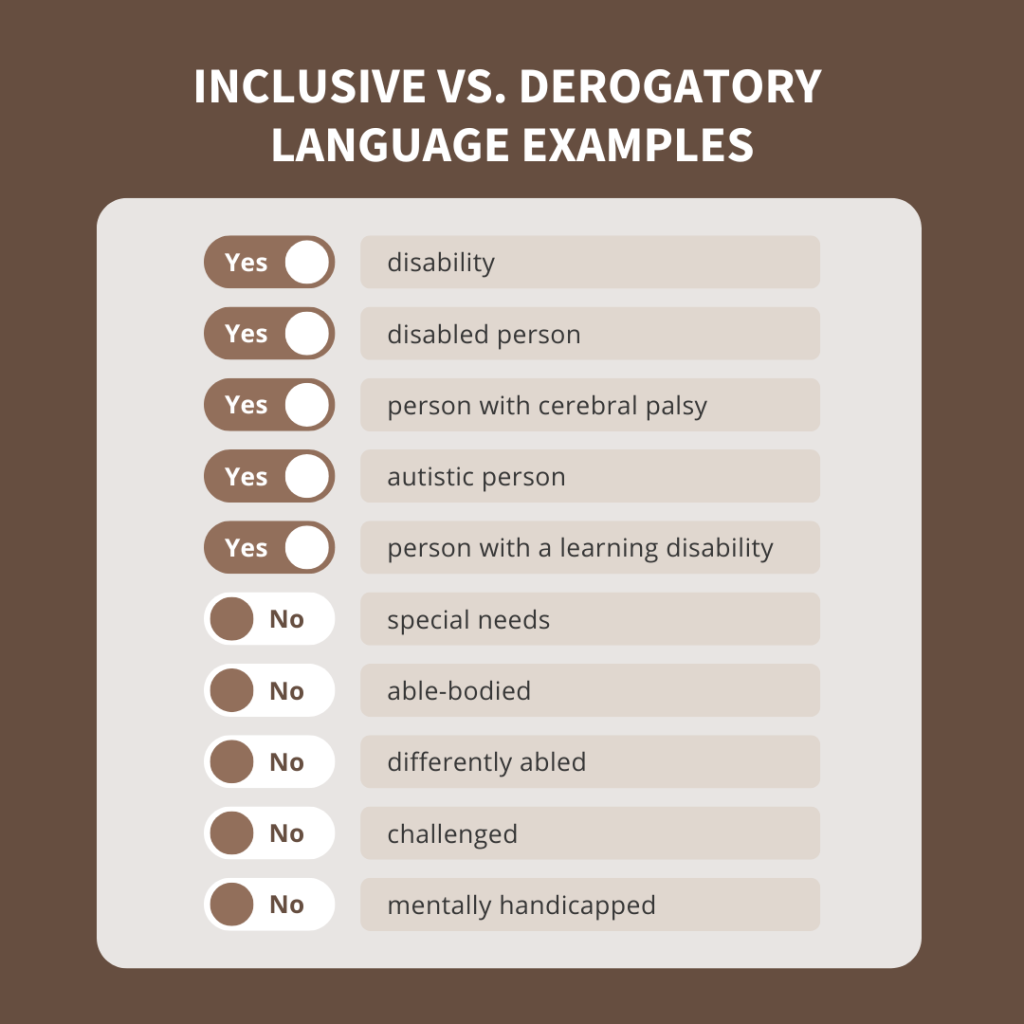
A graphic titled "Inclusive vs. Derogatory Language Examples" illustrates various disability-related terms, highlighting which are respectful and which perpetuate stigma.

We avoid “special needs” because all children have needs, and disability is not a negative term. By using clear, respectful language, we work to ensure that children with disabilities are fully included in their communities and empowered to thrive.